
Gone are the days when pairing passion with purpose had to come at a cost. We do not have to sacrifice our prosperity to help our communities prosper. Until recently, social wellbeing was primarily left to the not-for-profits, NGOs and government. Corporations have contributed via their Corporate Social Responsibility strategies but again, at a cost, certainly not as an economic profit strategy. Most believe social progress and economic profits are mutually exclusive, this is simply not true. Economic profits may be used for social progress but few know that social progress can create highly sustainable economic profits. This is at the core of the shared value movement. Shared value strategies are rich in both tangible and intangible profit opportunities that have positive impact on both corporations and their communities. This means our current perceptions of profit, responsibility, giving and philanthropy will be radically transformed over the next 5 years.
This is by no means a new concept; pioneers of shared value have been evolving and working with corporations to prove these concepts for the past decade. So then why are we now finally paying attention? Because this is no longer a theory; there are numerous smart companies like Google, Nestle, J&J, Molson Coors Brewing, IBM, GE, and Wal-Mart, just to name a few, that have proven and measured the enormous economic and social benefits of creating shared value. Another reason is that we are simply ready; the legitimacy of our business community had fallen to an all time low, this has forced us to reexamine capitalism at its core.
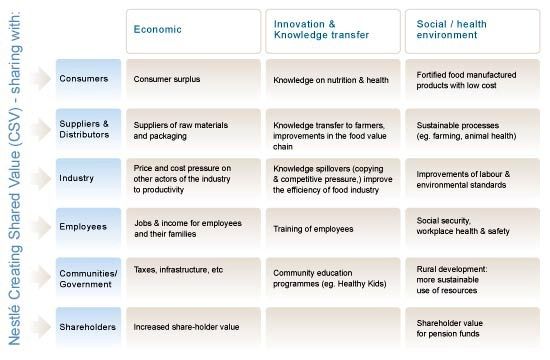
Shared value was coined by the brilliant Michael Porter and Mark Kramer, authors of Harvard Business Review’s Creating Shared Value. Fundamentally, they provide three key ways that companies can create shared value opportunities: by reconceiving products and markets; by redefining productivity in the value chain; and by enabling local cluster development. Their article provided the awareness and credibility this movement needed through sustainable and highly repeatable examples to illustrate the breadth and potency of these principles. The most powerful example to date is Nestle. Nestle has injected shared value into the core of their business. Chairman and CEO, Peter Brabeck-Letmathe says “It is our firm belief that, for a company to be successful over time and create value for its shareholders, it must also create value for society.” Nestle is not just claiming to do business this way, they are proving it. Most importantly, they are measuring their performance and reporting results. This matrix diagram was developed as a conceptual framework to measure a company’s overall net impact on its stakeholder groups.
Another significant strategic contributor to rethinking capitalism is Umair Haque, author of The New Capitalism Manifesto. Haque believes that our business community has outgrown the old paradigm of short-term growth, competition at all costs, adversarial strategy, and pushing costs onto future generations. This is why today we primarily see what Haque calls “thin” value versus “thick” value. Thick value is enduring, meaningful, and a sustainable advantage that deeply benefits the society at large. Haque has developed methods intended to bring us from “value chains to value cycles”; from “value propositions to value conversations”; from “strategy to philosophy”; from “protecting a marketplace to completing a marketplace”; and from “goods to betters”. As with the principles of shared value, thick value, will produce sustainable prosperity for business as well as society.
What does all this mean for businesses? Businesses need to fundamentally rethink their purpose. They need to carefully examine the social impact of their products and services and explore how they can maximize the benefits for their entire value cycle. That is not as daunting as it may sound; in fact it is remarkably doable. In my next article we will dig deeper into the best ways for you to begin to create shared value.